
Blog
Faith in the Age of AI: Understanding Your Divine Worth in a Digital World
· 6 min read
Before any algorithm scored you, God paused and decided on you. Week one of Faith in the Age of AI: why your worth cannot be computed, from Genesis 1.
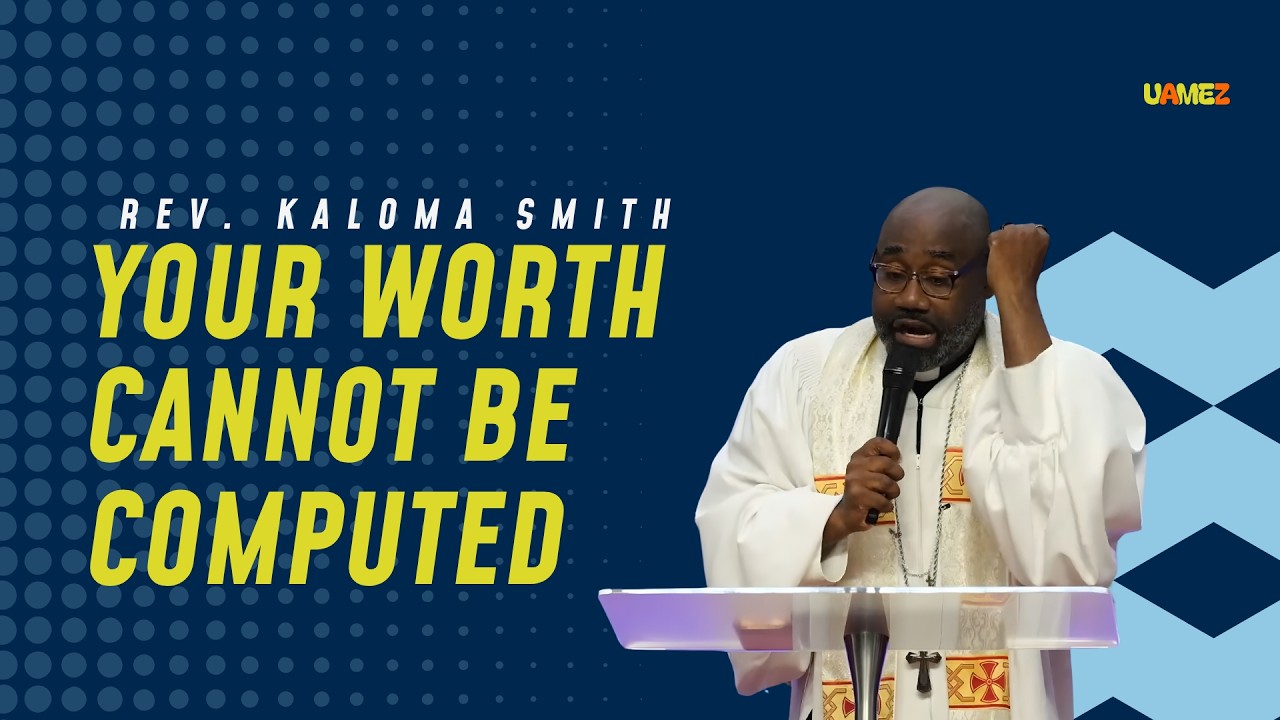
Sermon from Sunday, April 12, 2026 · Genesis 1:26-28 · Faith in the Age of AI, week 1
Watch the videoOpens in a new tabI want to start this series with the most honest thing I can tell you.
This spring Larin and I flew our seven-year-old and our two-and-a-half-year-old to New Jersey for my mother’s milestone birthday. Our family is spread all over the country, so we are intentional about the FaceTimes, the photos, and the texts. But distance has a way of making relationships theoretical. When we walked into my mother’s house, the boys were hesitant with family they had seen on a screen a hundred times. It is one thing to talk to somebody on FaceTime. It is another thing to be in the room with them.
You cannot synthesize real connection. The real thing costs you something. It costs your attention. It costs being there.
We live in a moment where a lot of people believe they do not need the real thing. A woman in Japan put on a gown and a tiara and exchanged vows with an AI avatar. One in five American adults has used a chatbot to simulate a romantic partner, including a widower here in Silicon Valley who lost his wife of thirty years, built an AI companion to fill the space she left, and still wears his ring. There is an app in the App Store that advertises an AI companion with a soul.
That is not confusion. That is hunger. A deep desire for someone to actually be there, for presence that has weight, for being known by something that cannot be turned off. Anything artificial will never reach that depth. So over eight weeks we are going to talk about faith in the age of AI, and we are not starting with the technology. We are starting with you.
Made in the image
Genesis 1:26-27: “Then God said, ‘Let us make man in our image, after our likeness.’ ... So God created man in his own image, in the image of God he created him; male and female he created them.”
The image of God in human beings is not a fringe Methodist idea. Orthodox, Catholic, Protestant, Pentecostal: we all hold it. It is why the church stood against slavery, which was not merely an economic injustice but a theological assault on God’s own designation of human worth. It is why this church marched in the civil rights movement, because Jim Crow was a theological lie. It is why this building is open to every culture, background, and gender, not as a social policy but because we see the image of God in the people who walk in.
The attack on that image is not new. What is new is the form. Sometimes it wears the face of innovation. Sometimes efficiency. Sometimes it fits in your pocket and says it has a soul. The question we will ask for eight weeks is simple: does this system honor the image of God in every person it touches?
You were decided on
For twenty-five verses, God speaks and it is. Light, sky, land, sea, stars, birds, fish, animals. No pause, no deliberation. Then verse 26 changes. God stops speaking outward and speaks within himself: “Let us.” It is the first deliberation in the entire creation story.
Everything else was spoken into being. You were decided on. The most deliberate act in history is you.
Now think about the world we actually live in. Kindergarten grades. Who plays and who sits. I have done lunch duty at an elementary school, and the social dynamics of five-year-olds look exactly like the social dynamics of forty-year-olds: who sits at which table, who gets invited. Then the GPA, the SAT, the college, the internship, the title, the salary, the floor of the building, the car in the driveway. We build our value out of all of it, and it is exhausting, because it runs backwards from God’s design.
Romans says Christ died for us while we were still sinners. Not after we cleaned up. God saw value in us first. In Genesis the order is declaration, then blessing, and only then an assignment. Your worth is not based on the car, the title, the school that accepted you, the score, the follower count, or who voted for you. Psalm 139 says your days were written in God’s book before one of them came to be. The world’s book had no vote.
Genesis 1:27 uses the word created three times, as if God knew we would need to hear it more than once. So hear it. You carry a designation older than any metric currently measuring you. Stop letting the world’s evaluation system have the last word. This year, learn to be unbothered.
Your worth cannot be computed
Let me make you uncomfortable. In the twentieth century, the most sophisticated medical and scientific community in the Western world built a program on a simple premise: human lives can be evaluated by their measurable contribution to society, and lives judged insufficient can be ended. The people running it were not irrational. Their rationality was operating without Genesis 1:27. Nuremberg, Geneva, and the Universal Declaration of Human Rights only wrote down what Genesis had declared for thousands of years: human worth cannot be granted or revoked by any system of evaluation.
The résumé screener that never shows your application to a human because your zip code flagged you is operating without Genesis 1:27. So is the app that says it can give you a soul. Not always out of malice. But none of them are the Creator, and only the Creator sets the price of a human being.
Jeremiah 1:5: “Before I formed you in the womb I knew you, and before you were born I consecrated you.” Before the zip code, before the algorithm, before any machine was built, the answer was not a score. You were known.
That is true for the person whose Alzheimer’s is taking someone they love piece by piece. The person is changing. The image of God in them is not. It is true for the person who has been incarcerated and told their worth was permanently recalculated. For the person with a disability, the person who is neurodivergent, the person carrying choices they cannot take back. A week ago I stood here hoarse over an empty tomb. The resurrection is God’s loudest declaration that the verdict of Genesis 1:27 has not been revoked. Isaiah 43:19: behold, I am doing a new thing.
Built to represent, not just produce
Notice the order in verse 28. God blessed them, then commissioned them, then gave them a role. The first human experience in the Bible is not work. It is being addressed by the Creator. Let me say that for Silicon Valley: the first human experience is not work. We do not need work-life balance. We need life-work balance.
When powerful things are stewarded without love and justice, you get exploitation instead of stewardship, extraction instead of care, efficiency instead of justice. That is the diagnosis of our moment. So when we talk about AI, four questions. Who designed it, and what values are built in? How does it read human beings, and whose definition of value is the standard? Who deploys it, and who bears the cost of the displacement? Who is in the room when the decisions are made?
Not every person it was designed for. Every person it touches. The worker it displaces. The people in other countries paid pennies to filter the worst images so the models stay polite. The applicant screened out for not having the right school on the résumé. Micah 6:8 is the standard for every image-bearer in those rooms: do justice, love kindness, walk humbly. The Christian in the AI ethics meeting is the one who keeps asking the question the room does not want to stop and answer.
The deepest wound in this valley is not that people have stopped performing. It is that people have stopped being. They have collapsed the distance between what they do and who they are until there is no space left.
This week
Jeremiah 29:11: “For I know the plans I have for you.” Plans, not reactions. Written before your first breath.
Go back to those offices and meeting rooms as someone who knows something those rooms cannot generate. You are not reducible to your output. You cannot be replaced by a more responsive, more agreeable system, because what you carry is not a feature set. It is the image of the living God.
Our ancestors lived forward when the world was on fire. This church stands in that line, and the world is on fire again, with systems that cannot fill deep desires and app stores selling souls. We will do what they did. We will be the community where dignity is not computed. It is declared.
Sit with these:
Where am I letting an algorithm, a metric, or someone’s opinion have the last word on my worth?
Whose image of God am I failing to see: at work, in my family, in the systems I help build?
What is one room I am in where I could be the person who asks the question nobody wants to answer?
See you Sunday.
Pastor Kaloma Smith