
The Full Story Behind Our $400,000 Grant

The images in this post are design renderings only. The final project will look different based on City of Palo Alto permitting, input from the National Trust for Historic Preservation, and other factors.

A few months ago, I shared that the National Trust for Historic Preservation awarded University A.M.E. Zion Church a $400,000 grant through the African American Cultural Heritage Action Fund. Today I want to tell you the whole story. What this money will do. When you will see it. And why, when you know our history, this feels like nothing less than the hand of God.
Before the buildings and the budgets, the reason. Everything we do flows from one desire: to create a space for community. A place where people are known, where neighbors belong, and where the love of God shows up in real relationships. Every steel pier, every walkway, every drop of paint in this project serves that one purpose.

Our history: 1918, a living room on Cowper Street
Our story began with a small group of believers gathered in a home on Cowper Street to establish an A.M.E. Zion church in Palo Alto.
In 1923, they purchased property at 819 Ramona Street and built our first sanctuary in a city that was writing racial covenants directly into its property deeds, neighborhood after neighborhood. As early as the 1920s, our leaders publicly called those policies un-American. This congregation was a voice for civil rights decades before the movement had a name.
When the Great Depression threatened that little church with foreclosure, Palo Altans of every background rose up and helped burn the mortgage. For forty years, Ramona Street was home, the anchor of Black Palo Alto. That building still stands today, a recognized landmark of courage and community.
That is not luck. That is God, working through generations of people like you.
Our home: sixty years on Middlefield Road
On July 4, 1965, we broke ground at 3549 Middlefield Road. In January 1966, the sanctuary was complete.
This was no ordinary church building. Architects Reginald F. Inwood and Albert A. Hoover gave us a rare example of mid-century modern sacred architecture built by and for a Black congregation. Natural materials. Open breezeways. A central courtyard designed as an extension of the sanctuary itself. The architecture preached before we did. It declared openness and welcome in a region where Black presence was pushed to the margins.
This year marks sixty years on Middlefield Road, the longest we have been in one location in our entire 108-year history. Generations have been baptized, married, discipled, and sent home to glory from this campus.
I want you to sit with that. We are the oldest continuously operating Black church in Silicon Valley. We stood through covenants that said we could not own. Redlining that said we could not borrow. The 1918 pandemic, the Great Depression, Jim Crow, COVID. Today, in a city where the Black population has declined to 1.5 percent, this church remains a living testament to more than a century of Black presence, belonging, and prophetic leadership in Palo Alto.
That is not luck. That is God, working through generations of people like you.
And this restoration is about more than honoring a legacy. Our vision is for this campus to become an even more vibrant community hub, where neighbors gather, fellowship spills into the courtyard, and Silicon Valley finds connection in a region starving for it. We are not preserving a monument. We are preparing a home.

Founded 1918. 108 years of ministry. $400,000 grant awarded.
The project: what $400,000 will actually do
One note first. This restoration is one of two major projects on our campus this year. The other is our Clean Energy Hub, a separate effort with its own funding that will bring solar power, battery storage, and energy resilience to our campus and community. You will hear about the Energy Hub on its own. Today is about preservation.
This is not a patch job. Here is exactly what is happening.
1. Saving the Little House
The Little House is the oldest structure on our campus, built in the 1920s, decades before we arrived on this land, a place for us to gather. Today it serves our youth ministry, hospitality, and small groups. And it is in real trouble: widening cracks, shifting floors, a basement that floods even in dry season, and doors that no longer open. Without intervention, it would have been unusable within the next few years. Instead, this grant allows us to save it with a full engineered rescue: steel piers to stabilize the foundation, support jacks beneath the floors, complete basement and crawlspace encapsulation with drainage and sump pumps, and removal of the invasive tree roots causing the damage. You cannot build a future on a compromised foundation. In a building or in a life.

2. The courtyard
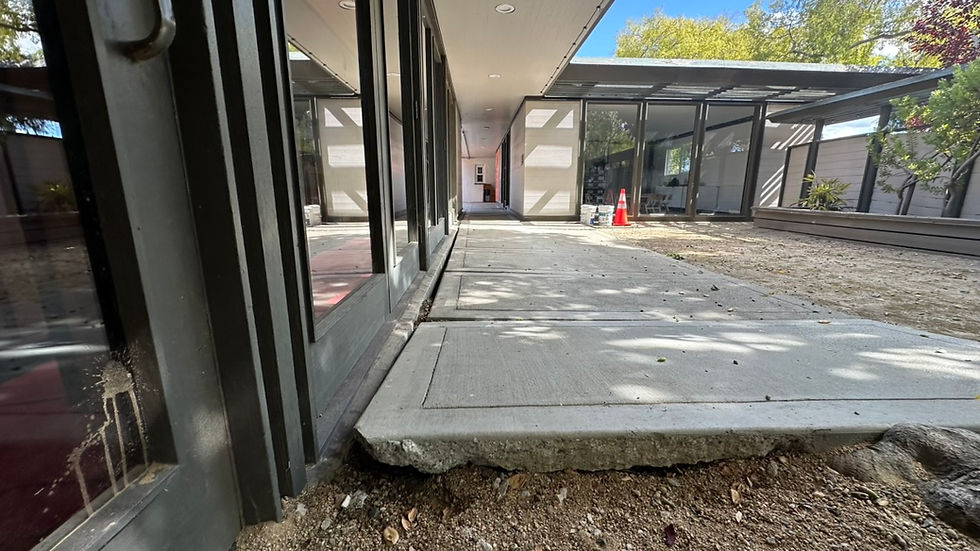
Our courtyard was designed as an extension of the sanctuary itself, a sacred space for reflection, fellowship, and connection. Sixty years of age and invasive tree roots have cracked and lifted the concrete, creating trip hazards and breaking the flow of a space meant to feel seamless. We will remove the invasive trees, install root barriers, repour smooth new walkways, and restore the courtyard as a signature gathering space for fellowship, outdoor ministry, and community life.



3. The trellis and architectural wall
The redwood trellis over the main entrance to the courtyard from the street is structurally unsound and in danger of collapse. That is a safety risk we can no longer defer. The courtyard trellis system has rotted, and the distinctive low architectural wall around the sanctuary is disintegrating. All of it will be removed and rebuilt with historically appropriate materials, restoring both the safety and the face our campus presents to Middlefield Road.


4. A protective coat on every building
The project concludes with protective exterior painting of every building on campus, shielding these restored structures from further wear. When this project is complete, our campus will look the way our worship sounds.

Who is doing the work
Our Trustees are leading and managing this entire effort. They have poured countless hours into planning, due diligence, and the care of every dollar. When you see them, thank them.
Numa Gardens, a Los Gatos landscape architecture studio, designed and laid out our garden, courtyard, and grounds. Design principal KC Carlisle, a UC Berkeley-trained landscape architect and licensed contractor, designs spaces that incorporate the land rather than impose upon it. It is hard to imagine a better match for a courtyard built to be an extension of the sanctuary.
Groundworks will handle the stabilization of the Little House, including the foundation piers and basement encapsulation.
MTL will execute the architectural trellis and trowel work.
Canterbury Contractors, a Santa Clara commercial painting firm trusted with some of the most demanding projects in the Bay Area for over 30 years, will paint every building on campus.
What happens when
July. All required paperwork has been sent to the National Trust in Washington, DC, and it has been received.
August. We anticipate receiving our initial funding.
August to September. We go to the City of Palo Alto for permitting, which we expect to take one to two months.
October and beyond. You should begin to see visible impact on our campus this fall, with work continuing through the winter and into next year.
I will update you at every stage. And let me prepare you now: a season of construction means a season of adjustment. Fencing where the courtyard used to be. Parking that shifts. Parts of campus off limits for a stretch. When you see it, do not see inconvenience. See answered prayer wearing a hard hat.
And this is only the beginning
Here is a detail worth celebrating. An outside donor has already committed $48,000 toward the plants and landscaping, in addition to the grant itself. God is moving people we did not even ask.
This grant gets the job started, and we are grateful to God for providing it. But this is a church with a bigger vision. The Fireside Room holds thirty people. The Little House holds fewer. We are planning to thoughtfully address that, with projects on the horizon beyond what the grant covers. I will lay out that vision separately, so there is no confusion about what this grant covers and what comes next.
Money for projects like that does not arrive in one large check. It never has here. In 1923 and in 1939, it came the way it always comes: many people doing their part. The same God who helped a handful of believers buy property in a town full of racial covenants, who moved a whole city to burn a mortgage, who built a sanctuary on Middlefield Road, just moved the National Trust to invest $400,000 in our future. Do you really think He is going to stop now?


What I am asking of you
Today, the ask is simple, and it is not money.
Respond. If you are part of the UAMEZ family, a survey is coming to you in the next few weeks, because before we decide anything, we want to hear from you, starting with the biggest question on the horizon: the new building. Take a few minutes and answer it. It will ask what you see, what you need, and what you believe this campus should become. This is not a formality. Your answers will shape what we pursue and in what order. After the survey, we will pray together as a church. And this fall, we will launch a campaign toward the full vision. We will set a goal only God can fill, because that is the only kind of goal worthy of this church's history.
Pray. Ask God what part of this next chapter He might be calling you to carry. Pray for the crews who will work on this campus and for their safety. Pray for our Trustees as they manage every detail. Pray for wisdom as we discern the vision together. And pray honestly about your own part, because I am not asking you to say yes to me. I am asking you to listen for whether God is speaking to you in this. Come to this fall having already had that conversation with Him.
Give. If you feel led to give today, your gift supports the overall improvement of our campus as time and resources come together, not one project or another. And hear me on this: a predictable gift is more powerful than a big one, because it lets us plan instead of react. You can give during service, by text, or anytime at uamez.com/give. If you want to explore giving stock, a donor advised fund, or an employer match, email info@uamez.com and we will walk you through it.
Our root desire has not changed in 108 years. We exist to create a space for community, a place where people belong to God and to one another. Long after the paint dries, that is what will remain. That is the work. Everything else is just the tools.

Read more: the National Trust's announcement of the 2026 Preserving Black Churches grantees, and Palo Alto Online's coverage of our plans.
We are grateful to God for all He continues to do. And we go from here.
Your Pastor,
Pastor Kaloma Smith
University A.M.E. Zion Church
P.S. The next time you walk under the courtyard trellis, take a picture. You are looking at the before.

Comments